Fuel-free generator.

👤 Author: Veles 📅 13.07.2026 12:50 🏷️ Category: Science and Research 💬 Posts: 12 📁 Project: Fuel-free generator.

Building a fuel-free generator yourself: hydraulic ram pumps, magnet generators, power calculations. Sharing experience, drawings, and diagrams for a small hydroelectric power plant.

#1

Hi everyone! I've had an idea for a long time to create a BTG based on the principle of a water mill, but after calculating the costs of lifting water and the amount needed to produce at least 20 kilowatts of electricity, the numbers didn't add up. Today I saw a video

about the "Water Pump" and decided to recalculate and check everything once more.

#1

And how will a hydraulic ram pump help?

#1

Using several hydraulic ram pumps, water can be lifted from a lower reservoir to an upper one, and if the volume of the lifted water is proportional to the rate at which the mill's blades are filled, it is possible to generate enough electricity to power homes, businesses, and, depending on the scale, various types of charging stations.

#2

Is there a principle of operation for the final installation?

#1

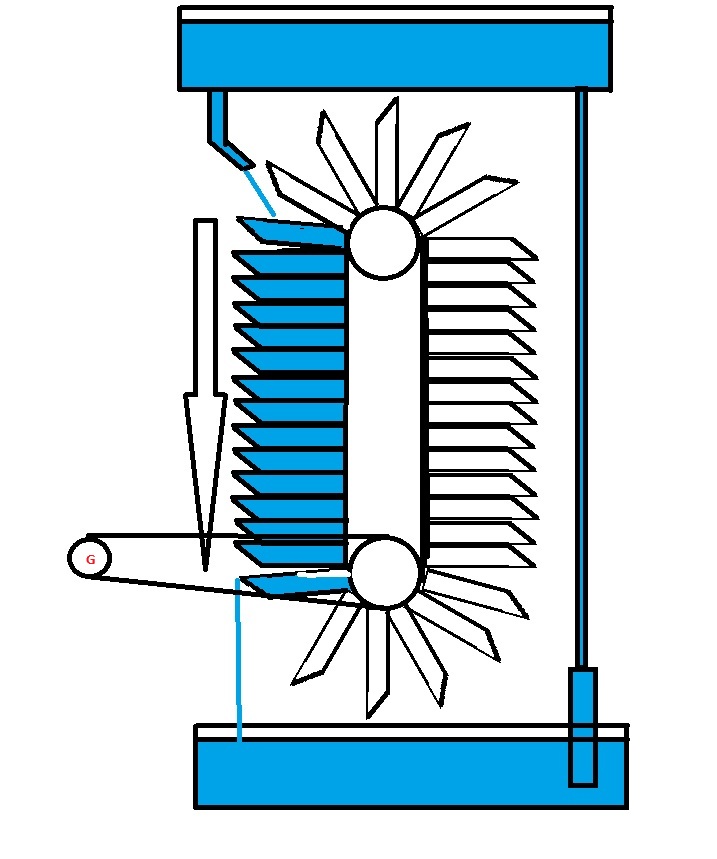
Well, it's not in the blueprints yet, but here is a general view:

The drawing on the right schematically depicts a pump, but considering my previous calculations, the installation will not be able to produce free energy. However, if a hydraulic ram pump is used instead of a conventional pump, the entire profitability of the installation will depend specifically on it.

#2

Oh, so in the end it should turn out something like this?

#1

Yes, if the water is pumped using electric pumps, my calculations show that obtaining free energy is not possible, but if the water is lifted by a hydraulic ram pump, or pumps, it is quite possible to obtain a decent amount of BTU.

#3

Has anyone here worked with hydraulic ram pumps? I am interested in their designs and performance. We have already started working on a prototype of the installation, but I would like to understand how these types of pumps work and what factors can be used to increase their output?

#4

Hi everyone! Following up on this topic: has anyone here actually worked with water hammer pumps in practice or built one yourself?

I'm very interested in real-world data and experience:

1) What are your pressure, flow rate, and efficiency levels across different setups?

2) What delivery pipe diameters, lift heights, and valve parameters did you choose?

3) How did you manage to increase output and eliminate the "knocking" sound?

Please share your designs, calculations, drawings, and links to reliable sources (videos, articles, forums). Based on your responses, I plan to compile a detailed guide on water hammer pumps and the operating principle of our setup—complete with formulas, diagrams, and a collection of external resources—so that anyone can quickly understand the concept and build their own prototype.

The more unique, useful content, working links, and discussions we have in this thread, the better the chances of the project and the forum ranking higher in search engines. Thanks in advance for your answers!

#5

Hi everyone! Continuing our discussion of our fuel-free generator prototype, I want to take a detailed look at the generator part of the setup so that we end up with a fully calculated working scheme.

Who among you has already built a generator yourself for a small hydro installation (water wheel, low-speed shaft)? Please share your experience:

1) Which generator did you choose: a car alternator, a permanent magnet generator (PMG), or a regular asynchronous motor converted into a generator? What actual output power did you get at your shaft speed?

2) How did you select the gearbox ratio for the generator's optimal speed? Were you able to achieve smooth load regulation without sharp voltage drops?

3) What efficiency did you measure across the entire chain: water flow → runner → gearbox → generator → battery/inverter? Do you have your measurements and calculation formulas?

4) If you wound the coils yourself — what wire, cross-section, and connection scheme (star/delta) did you use?

5) Which sources (books, articles, drawings, videos) on calculating small generators do you consider most reliable? I would appreciate links.

I am putting together a detailed practical guide from your answers, “DIY Fuel-Free Generator: Generator Selection, Calculations, Efficiency, and Common Mistakes,” so that any community member can quickly reproduce our scheme.

The more actual figures, formulas, and external sources appear in the topic, the more useful the material will be for the entire community and the higher the project will rank in search results for queries such as “DIY fuel-free generator,” “permanent magnet generator,” and “small hydroelectric power plant.” Thanks in advance for your replies!

.

#6

Another principle of how a hydraulic ram works:

#1
Yes, this scheme is best suited for our BTG. We need to calculate the parameters of such a pump for lifting water to a height of 10 meters, and its submersion depth for a flow rate of 5 cubic meters per minute.
Log in or join the project to leave a message.

Add post

Answer for:

Edit topic